Belgium & Netherlands
Trip Route Overview
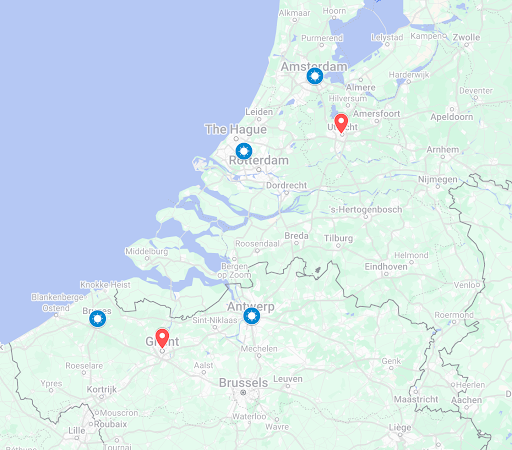
🇧🇪 🇳🇱 Belgium & Netherlands Trip Route: Ghent - Bruges - Antwerp - Utrecht - Delft - Amsterdam
🗺️ Trip Overview
Welcome to your unforgettable journey through Belgium and the Netherlands, where centuries of history, art, and culture meet picturesque canals, medieval architecture, and culinary delights.
Your adventure begins in the medieval beauty of Ghent, Belgium, with its stunning castle, winding canals, and vibrant local scene away from the tourist crowds.
From Ghent, you'll venture to the fairytale-like charm of Bruges for a day trip, where chocolate shops, breweries, and cobblestone streets create a truly magical atmosphere. Before heading to the Netherlands, you'll enjoy a brief exploration of Antwerp, known for its impressive architecture and fashion scene.
In the Netherlands, Utrecht will serve as your home base - a delightful university city with canals and a historic center without Amsterdam's tourist crowds. From here, you'll take day trips to charming Delft with its famous blue pottery and iconic Amsterdam with its distinctive canal rings and lively atmosphere. And as a special bonus, you'll be in the Netherlands during tulip season and for King's Day (April 27), one of the country's biggest celebrations!
Throughout your journey, you'll discover local cafés and brown bars, sample distinctive regional specialties from Belgian chocolate and beer to Dutch stroopwafels and jenever, and immerse yourselves in the laid-back yet vibrant culture of these two fascinating countries.
Remember: This trip is an adventure. We get to go to the most incredible places. Unexpected and unplanned things will happen and we will find ways to roll with them like we always do. We can handle anything. Everything is figure-out-able. This will become an amazing story.
Day-by-Day Itinerary
Day 1
Begin your journey to Belgium & the Netherlands.
Day 2
Arrival and first exploration of Ghent.
Day 3
Explore the fairytale city of Bruges.
Day 4
Discover the medieval beauty of Ghent.
Day 5
Option day: Second day in Ghent or Bruges.
Day 6
Visit Antwerp and travel to Utrecht.
Day 7
Discover Delft's famous blue pottery.
Day 8
Explore Utrecht's canals and historic center.
Day 9
Discover Amsterdam's timeless canals and cultural treasures!
Day 10
Option day: Second day in Amsterdam or Utrecht or Tulips Experience.
Day 11
Return home with souvenirs and memories.
🌷 Inspiration
"The real voyage of discovery consists not in seeking new landscapes, but in having new eyes."
— Marcel Proust"Tourists don't know where they've been, travelers don't know where they're going."
— Paul Theroux"Travel makes one modest. You see what a tiny place you occupy in the world."
— Gustave Flaubert"We travel not to escape life, but for life not to escape us."
— Anonymous"To travel is to discover that everyone is wrong about other countries."
— Aldous Huxley🗣️ Language Quick Reference
Dutch/Flemish Phrases
Dutch is spoken in the Netherlands and northern Belgium (as Flemish). Both variants are very similar, with small pronunciation differences. Here are essential phrases for your trip:
- Hello/Good day - Hallo/Goedendag (HOH-loh/KHOO-den-dakh)
- Goodbye - Tot ziens (TOT zeens)
- Please - Alstublieft (AHL-stoo-bleeft)
- Thank you - Dank u wel (Belgium) (DAHNK-oo-vel)
- Thank you - Dank je wel (Netherlands) (DAHNK-yuh-vel)
- Yes/No - Ja/Nee (YAH/NAY)
- Excuse me - Excuseer (ex-koo-ZAIR)
- Excuse me - Pardon (par-DON)
- Do you speak English? - Spreekt u Engels? (SPRAYK oo ENG-els)
- Cheers! - Proost! (PROHST)
Pronunciation Tips
- The Dutch 'g' sound is a guttural sound made at the back of the throat
- The letter combination 'ij' is pronounced like 'ay' in "day"
- Dutch 'oe' sounds like 'oo' in "boot"
- Dutch 'ui' has no English equivalent but is close to 'ow' in "how" with rounded lips
- The letter 'v' is pronounced softer than in English, between English 'v' and 'f'
Most Dutch and Belgian people in tourist areas speak excellent English, but they'll appreciate your effort to use a few Dutch phrases!
🍫 Belgian Culture
Language
Belgium has three official languages: Dutch (Flemish) in the north, French in the south, and German in a small eastern area. In Ghent and Bruges (Flanders region), Dutch is the primary language, but most people speak excellent English.
French is more common in Brussels and southern Belgium (Wallonia). In tourist areas, you'll find staff who speak multiple languages. See the Language Quick Reference section for essential phrases.
Food & Drink
Belgian Specialties
- Waffles: Brussels waffles (rectangular, light and crispy) and Liège waffles (round, dense, and sweet with pearl sugar)
- Chocolate: Belgium produces over 172,000 tons of chocolate per year with over 2,000 chocolate shops
- Frites (Fries): Claim to be the original inventors, twice-fried and served in paper cones with a variety of sauces
- Mussels: Often prepared with white wine or beer (Moules-frites)
- Carbonade Flamande: Beef stew cooked with beer
- Waterzooi: Creamy stew with fish or chicken
- Stoemp: Mashed potatoes with vegetables
- Speculoos: Spiced shortcrust biscuits
Belgian Beer Culture
Belgian beer is world-renowned with over 1,500 different varieties. Beer in Belgium is more than just a drink; it's a cultural institution with its own rituals and traditions.
- Trappist Beers: Made in monasteries (only 6 in Belgium)
- Abbey Beers: Brewed according to monastery traditions but not necessarily in a monastery
- Lambic Beers: Spontaneously fermented beers unique to the Brussels area
- Fruit Beers: Often lambics with fruits added (cherries, raspberries, etc.)
- Dubbels, Tripels, Quadrupels: Refer to strength and brewing methods
- Proper Glassware: Each beer has its own specific glass shape designed to enhance its particular qualities
Meal Times & Customs
- Breakfast: Typically simple - bread, jam, cheese, coffee
- Lunch: Usually 12-2pm, can be the main meal of the day
- Dinner: Between 6-8pm, often lighter if lunch was substantial
- Cafés & Bars: Belgians love their cafés as social spaces, open through the day
- Tipping: Not required as service charge is included, but rounding up or adding 5-10% for excellent service is appreciated
Cultural Etiquette
- Greeting: A handshake is standard for first meetings. Three kisses on alternating cheeks is common between close friends (women or women and men)
- Punctuality: Belgians tend to be punctual, especially in Flanders
- Dining: Keep hands (not elbows) on the table while eating
- Politeness: Directness is valued but always coupled with politeness
- Quiet enjoyment: Belgians tend to be more reserved in public spaces compared to some other cultures
🧀 Dutch Culture
Language
The official language is Dutch, though nearly everyone in tourism and most younger Dutch people speak excellent English. Dutch is closely related to German and English, but with unique pronunciations and vocabulary.
While English is widely spoken, locals will appreciate your effort to use a few Dutch words. See the Language Quick Reference section for essential phrases.
Food & Drink
Dutch Specialties
- Stroopwafels: Thin waffles stuck together with caramel syrup
- Hagelslag: Chocolate sprinkles eaten on buttered bread (yes, really - for breakfast!)
- Bitterballen: Deep-fried crispy meatballs served as bar snacks
- Haring (Herring): Raw herring served with onions, often eaten by holding it by the tail
- Poffertjes: Tiny, fluffy pancakes served with powdered sugar
- Stamppot: Mashed potatoes mixed with vegetables (traditional winter food)
- Gouda & Edam: Famous Dutch cheeses
- Oliebollen: Deep-fried dough balls, similar to donuts (traditionally eaten on New Year's Eve)
- Rookworst: Smoked sausage often served with stamppot
Dutch Drinking Culture
- Coffee: The Dutch consume among the most coffee per capita in the world
- Beer: Pilsner is the most common style (Heineken, Grolsch, Amstel)
- Craft Beer: Growing scene, especially in Amsterdam and Utrecht
- Jenever: Traditional Dutch gin, predecessor to modern gin
- Brown Cafés: Traditional Dutch pubs with dark wood interiors, named for their nicotine-stained walls from years past
Brown Cafés
These are traditional Dutch pubs that have existed for centuries, often with dark wood interiors, candles, and a cozy atmosphere. They serve beer, jenever, and simple food. A great place to experience authentic Dutch culture.
Meal Times & Customs
- Breakfast: 7-9am, often simple with bread, cheese, and coffee
- Coffee time: 10-11am with a small sweet treat
- Lunch: 12-2pm, traditionally a quick, lighter meal
- Borrel: Drinks and snacks after work, around 4-6pm
- Dinner: Earlier than in southern Europe, typically 6-8pm
- Tipping: Not required but 5-10% is appreciated for good service
Cultural Etiquette
- Directness: The Dutch are famously direct in conversation - they value honest communication
- Punctuality: Arrive on time or even a few minutes early
- Cycling culture: Respect bike lanes and cyclists - they have priority
- Weather talk: A common conversation starter due to the country's changeable weather
- "Going Dutch": The phrase comes from here - splitting the bill is common practice
Sustainability
Both the Netherlands and Belgium are environmentally conscious:
- Tap water is excellent quality and safe to drink
- Bring reusable bags for shopping
- Recycling is taken seriously
- Public transportation is efficient and well-used
- The Netherlands especially is bike-friendly
King's Day (April 27)
This is the biggest Dutch celebration of the year, marking King Willem-Alexander's birthday. The entire country turns orange (the national color) with:
- Flea markets (vrijmarkt) where anyone can sell items
- Street parties and live music
- Orange-themed everything
- Boat parties on the canals
- Festive atmosphere everywhere
This will be one of the highlights of your trip, falling perfectly during your stay!
✏️ Personal Notes
Travel Tips & Goals
- Always have a small umbrella or rain jacket - weather can change quickly in both countries
- Bring comfortable walking shoes - cobblestone streets can be rough on feet
- Try to learn and use at least a few words in Dutch
- Shop at local markets for unique souvenirs beyond fridge magnets
- Keep small coins for public toilets (often charge €0.50-€1)
- Capture photos of canal reflections - early morning or sunset offers the best light
- Try something completely new each day
- Take lots of videos this time
To-Do Before Trip
- Download offline Google Maps for Ghent, Bruges, Utrecht, Amsterdam
- Download a good translation app (Google Translate allows you to download Dutch for offline use)
- Get some euros from your bank before departure
- Check your credit cards for foreign transaction fees
- Notify banks of travel
- Pack adapters for European outlets (Type C/F, 230V)
- Check train schedules between cities
- Verify passport expiration dates (must be valid for at least 3 months beyond your planned departure date)
Packing List
- Rain jacket or small umbrella
- Comfortable walking shoes (2 pairs)
- Layers for variable spring weather
- Camera
- Portable charger
- European power adapter
- Small day bag/backpack
- Reusable water bottle
- Small first aid kit with pain relievers, band-aids
- Copy of passport and travel insurance info
Personal Daily Activity Goals
- Sit down for pastry and coffee in a cute shop
- Have a drink at a tavern or pub
- Walk along some water
- Have a snack or lunch in a park
- Buy a magnet
- Visit 2-3 cute shops and consider buying at least one thing artisanal or locally unique
- People watch and give 2-3 people personas